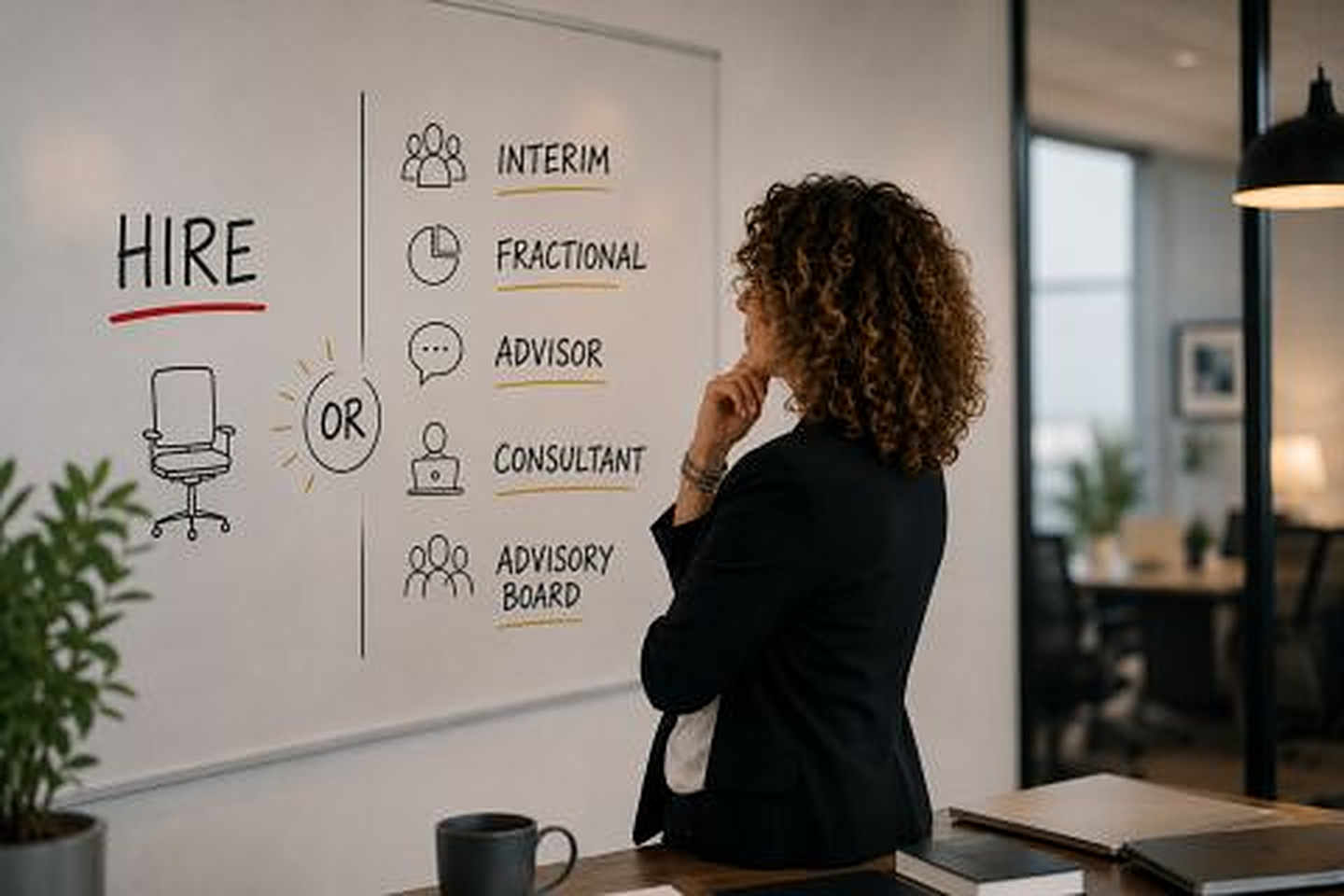
¿Estamos resolviendo el problema o estamos llenando una silla?Are we solving the problem, or filling a seat?
Cuando una empresa detecta una carencia —una capacidad que le falta, una transformación que quiere acelerar, un objetivo de crecimiento que no alcanza— la siguiente conversación suele girar en torno a quién hay que contratar. Y me pregunto si ese es siempre el punto de partida correcto.
La pregunta que no solemos hacernos
Durante muchos años, probablemente lo fue. Cuando se necesitaba experiencia en planificación estratégica, liderazgo de transformación, excelencia comercial o un perfil operativo senior, la respuesta más obvia era incorporar a alguien… de forma permanente.
Hoy, sin embargo, el mapa se ve muy distinto.
Un mapa que ha cambiado
En mi artículo anterior reflexionaba sobre cómo la IA transforma la manera en que trabajamos y decidimos cada día, siendo una de las fuerzas más disruptivas de nuestro tiempo. A la vez, el expertise en sí mismo está hoy más democratizado y al alcance de todos.
Para las pymes y las empresas familiares, este puede ser uno de los cambios más significativos de todos. Capacidades que antes estaban reservadas casi en exclusiva a las grandes corporaciones son ahora accesibles a través de modelos mucho más flexibles y eficientes en coste. Organizaciones de cualquier tamaño pueden acceder hoy a líderes muy experimentados, asesores especializados, interim managers y directivos fraccionales de formas difíciles de imaginar hace no tanto.
Un cambio de reglas de enorme calado.
El reto no es distinto; los recursos, sí
Porque la realidad es que las pymes se enfrentan a menudo a los mismos retos que las grandes organizaciones:
- Crecimiento.
- Ejecución.
- Transformación.
- Priorización.
- Escala.
Lo que tradicionalmente ha sido diferente no es la naturaleza del reto, sino los recursos disponibles para abordarlo. Hoy, una combinación de tecnología, nuevas formas de trabajar y modelos de talento más flexibles está ayudando, por fin, a cerrar esa brecha.
Acceder al expertise es solo la mitad de la historia
El acceso al conocimiento es solo una parte. El verdadero reto es aplicar ese expertise de una forma que encaje con la realidad del negocio. Porque lo que funciona en una multinacional no funciona automáticamente en una empresa familiar.
Los retos de hoy rara vez son estáticos. Evolucionan, se solapan y a menudo exigen un expertise que es a la vez muy especializado y profundamente contextual. No basta con traer conocimiento: hay que saber traducirlo al terreno concreto de cada empresa, con su historia, su cultura y sus personas.
La pregunta correcta
Quizá la cuestión no sea solo qué expertise contratamos, sino cómo accedemos a él de la manera más eficaz. La silla vacía no siempre es el problema. A veces, cubrirla rápido solo aplaza la pregunta de fondo.
Lo que me devuelve al principio: ¿estamos contratando para resolver el problema, o simplemente para cubrir una silla?
¿Cómo está afrontando tu organización este cambio?
When a company identifies a gap — a capability it lacks, a transformation it wants to accelerate, a growth objective it isn't reaching — the next conversation often revolves around who needs to be hired. And I find myself wondering whether that's always the right starting point.
The question we rarely ask
For many years, it probably was. When in need of strategic-planning expertise, transformation leadership, commercial excellence or senior operational experience, the most obvious answer was to bring someone in… permanently.
Today, however, the landscape looks very different.
A map that has changed
In my previous article I reflected on how AI is changing the way we work and make decisions every day, as one of the most transformative forces of our time. At the same time, expertise itself is now more democratised and within reach.
For SMEs and family-owned businesses, this may be one of the most significant shifts of all. Capabilities once reserved almost exclusively for large corporations are now accessible through far more flexible and cost-effective models. Organisations of every size can today reach highly experienced leaders, specialised advisors, interim managers and fractional executives in ways that were hard to imagine not so long ago.
A massive game changer.
The challenge isn't different; the resources are
Because the reality is that SMEs often face many of the same challenges as larger organisations:
- Growth.
- Execution.
- Transformation.
- Prioritisation.
- Scale.
What has traditionally been different is not the nature of the challenge, but the resources available to address it. Today, a combination of technology, new ways of working and more flexible talent models is finally helping to close that gap.
Access to expertise is only half the story
Access to knowledge is only part of it. The real challenge is applying that expertise in a way that fits the reality of the business. Because what works in a multinational doesn't automatically work in a family-owned company.
Today's challenges are rarely static. They evolve, overlap and often require expertise that is both highly specialised and deeply contextual. Bringing in knowledge isn't enough: you have to know how to translate it into each company's specific ground — its history, its culture and its people.
The right question
Perhaps the question is not only what expertise we hire, but how we access it most effectively. The empty seat isn't always the problem. Sometimes, filling it fast only postpones the real question.
Which brings me back to the start: are we hiring to solve the problem — or just to fill a seat?
How is your organisation approaching this shift?